
Your data centre has left the chat… and the planet
Here's what data centres in space mean for AI, the planet, and why billionaires are obsessed with leaving Earth behind.

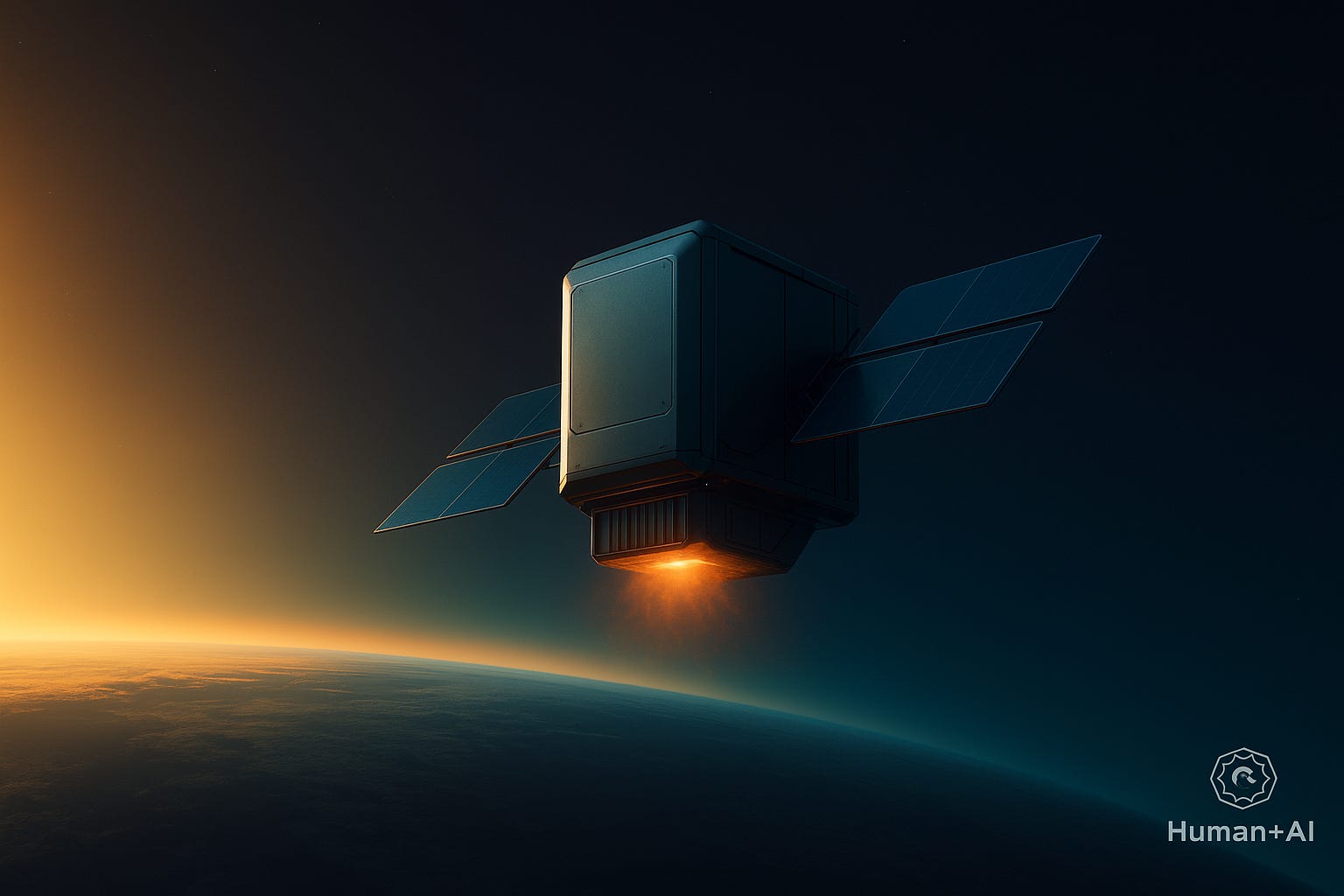
Last month, a Washington State startup Starcloud launched a satellite carrying the kind of chip that powers ChatGPT, an Nvidia H100 GPU, into orbit. According to the company, it’s working.
Starcloud-1 represents the first time a data-centre-grade processor has operated in space, a proof-of-concept that the cloud might one day extend beyond the atmosphere.
Meanwhile, Google has been developing something called Project Suncatcher, which is what it sounds like: satellites equipped with AI processors that would run on solar power 24/7, floating above the atmosphere where the sun never sets. The company says it wants to launch prototypes by 2027. Other tech giants are reportedly circling the idea too, with Business Insider calling it a “space data-centre race.”
The tech industry claims that space data centres promise unlimited clean energy, no zoning fights with angry neighbours, and a convenient 325 kilometres between you and anyone asking uncomfortable questions about your carbon footprint.
Before we all start imagining a WALL-E-style future where cloud storage lives in the clouds, let’s talk about what’s happening, and why the reality is messier than the marketing.
How do orbital data centres work?
Orbital data centres work a lot like the ones on Earth. They contain processors, power, cooling, and network links, but everything has to be reimagined for “vacuum.” Instead of drawing electricity from the grid, satellites unfold solar arrays that soak up uninterrupted sunlight. Instead of air or water cooling, they rely on huge radiators that glow infrared heat back into space, a bottleneck that limits how much computing they can do.
The hardware sits inside radiation-shielded modules built to survive cosmic rays and the violent shaking of launch. And instead of high-speed fibre, data moves through radio links to ground stations, which adds latency and caps bandwidth.
In practice, this means orbital data centres aren’t “the cloud in space” so much as highly specialized servers that can process certain kinds of data before sending it back to Earth.
The promise: unlimited solar power above the clouds
What makes space attractive for tech companies is that the sun never stops shining. On Earth, solar panels only work during the day, and even then, clouds and weather get in the way. In orbit, it’s high noon forever. For AI companies burning through electricity (training a single large language model can use as much power as a small town), that’s catnip.
Google’s pitch for Project Suncatcher explicitly leans on this: continuous solar power, no fossil fuels, no fights over water usage (data centres on Earth use millions of gallons for cooling), and no awkward conversations with local governments about why you’re building a warehouse-sized server farm in their backyard.
It sounds utopian, but it also sidesteps some inconvenient physics.
The problem: heat has nowhere to go
Energy is only half the equation. The other half is heat, and in space, heat is a serious problem.
On Earth, data centres use air conditioning and massive amounts of water to cool their servers. In space, there’s no air and no water. Heat has to be radiated away through large panels, and those panels are heavy. Every kilogram you send to orbit costs money, so the more cooling capacity you need, the more expensive your satellite becomes.
Tech publications have noted that even advocates of orbital data centres admit thermal management is the limiting factor, rather than power generation. Getting energy into your space server is easy. Getting the waste heat out is not.
Then there’s latency, the time it takes for data to travel between your phone and a server and back again. Starlink, which operates at similar altitudes, reports delays of about 25 milliseconds. That’s fine if you’re watching Netflix or scrolling Instagram. It’s a dealbreaker for anything that needs instant responses, like video calls, online gaming, or the kind of tightly coordinated AI training that tech companies are obsessed with right now.
So what would work in space? Things like processing satellite images before they’re sent to Earth, running pre-recorded data analysis, or handling tasks where a few extra milliseconds don’t matter.
Rockets are cheap now. Radiators are not.
Yes, SpaceX has made launching things into space way cheaper than it used to be. But “cheaper than the Space Shuttle” is a low bar, and mass still matters. A data centre isn’t just computer chips. It’s solar panels, batteries, cooling radiators, radiation shielding, and communication systems. All of that has to be lifted into orbit, and every kilogram costs.
On Earth, if a server dies, a technician swaps it out in minutes. In space, “on-orbit servicing” is still experimental and wildly expensive, which means that satellites need to be more reliable, last longer, and tolerate higher failure rates than anything on the ground. All of that drives costs up.
Starcloud’s promotional materials hint at massive savings from “free” solar energy, but those numbers are unverified and don’t account for the upfront cost of launching all that hardware, or replacing it when it inevitably breaks.
The business case is still theoretical. And until someone runs the numbers in the real world, it’s anyone’s guess whether this makes financial sense.
You can’t escape regulation by leaving the planet
One of the unspoken appeals of space, for some tech executives, seems to be the idea of escaping oversight. No environmental impact reviews, community input meetings, and no water boards.
But satellites are heavily regulated.
In the U.S., the Federal Communications Commission controls spectrum use and licensing. Internationally, the International Telecommunication Union coordinates frequencies. In Canada, we’re actively updating our frameworks for licensing space infrastructure. There are also growing international rules around orbital debris because space junk cluttering up low Earth orbit creates collision risks and liability nightmares.
So, you might avoid local zoning hearings. But you’re not avoiding the law. The bureaucracy just moves from the county level to the federal and international level.
Are data centres in space greener?
On one hand, solar power in space is genuinely clean once it’s up there, and orbital data centres wouldn’t use water or take up land. Google is pitching this as an environmental win.
On the other hand, rockets burn fuel. Satellites have to be launched, maintained, and eventually replaced. And when they reach the end of their life, they either burn up in the atmosphere or become space junk. Early attempts to model the lifecycle carbon cost of orbital data centres produce wildly different answers depending on assumptions about launch frequency, satellite lifespan, and the carbon intensity of rocket fuel.
The truth is that no one knows yet. The lifecycle assessment is unsettled, and any company claiming their space data centre is eco-friendly is making assumptions that haven’t been tested at scale.
The billionaire escape fantasy
Here’s what I’ve been thinking about lately: tech elites are obsessed with leaving Earth. Elon Musk wants to colonize Mars. Jeff Bezos talks about moving heavy industry into space. And now, Google and a growing list of companies want to move digital infrastructure into orbit.
There’s a pattern here, and it’s not subtle. When Earth gets messy with climate change, regulatory scrutiny, public backlash, and resource limits, the instinct isn’t to fix the problem on the ground. It’s to find a way out. To build somewhere new, somewhere with fewer rules and less accountability.
Space data centres fit neatly into that worldview. They’re technically elegant, logistically challenging, and conveniently distant from the people affected by the decisions being made. It’s the ultimate “move fast and break things” fantasy: infrastructure that exists above oversight, powered by the sun, answerable to no one.
Except that’s not how it works. Laws (and consequences) follow you. Physics don’t care about your pitch deck. And the carbon accounting is still to be determined.
Will your Instagram feed be powered from space?
Starcloud’s satellite proves that a high-end GPU can work in orbit, which is pretty cool from an engineering standpoint. Google’s timeline suggests a lot of research money is being spent. But there’s no business model so far.
Orbital data centres might make sense for very specific use cases, like processing data on satellites before sending it to Earth, running specialized analytics where bandwidth is expensive, maybe some forms of AI inference that don’t need tight coordination with ground infrastructure. But your TikTok algorithm won’t be running from space anytime soon.
The real questions are economic and political, not technical:
Which workloads actually justify the cost? Most computing tasks don’t need to be in orbit, and many can’t be, because latency matters.
At what launch cost does space beat Earth? No one has published credible, independently verified numbers yet.
Who gets to control orbital infrastructure? And who’s accountable when things go wrong?
Until those questions have real answers, space data centres are speculative infrastructure, not the future of the internet.
AI in the news
AI helps drive record $11.8 billion in Black Friday online spending (Reuters) AI-powered shopping tools drove a record surge in U.S. Black Friday online spending, with shoppers relying on chatbots to navigate higher prices, compare deals, and stretch tighter budgets. Despite rising costs and flatter discounts, AI-guided traffic jumped 805% year over year, helping push online sales to $11.8B and setting the stage for an even bigger Cyber Monday.
This week, I’m trying Elena Calvillo’s free AI Advent Calendar Challenge. Elena is challenging her followers to learn a new AI skill daily in December. You don’t have to worry about missing a day or two, you can catch up!
I also listened to the new episode of Diary of a CEO, in which Tristan Harris eloquently speaks to the real risks of AI and gives some practical advice around what we can do to ask our governments to enforce responsible AI adoption.


Thank you for breaking this down, truly. I love how you explain the logistics that no one seems to be questioning or thinking about. There's more to it than just the concept. There's a lot more variables, concerns and aspects to actually figure out.